

Dear Omar,
In which I attempt a response if not a reconcilliation.

This weekend an Episcopal priest I have never met commented twice on my post Faith. He said:
I’ve read a couple of your pieces. You say the church doesn’t want you anymore, but you very openly broke the rules, how do you reconcile both positions?
It seems like of a lot energy is spent lamenting not being a part of TEC. Do you attend services anymore or believe in Jesus Christ?
…and…
How do you reconcile your position on sexuality with the vows you took as a priest to adhere to the discipline of the Church?
Here is my response:
Dear Omar,
While I was camping this weekend, I read the comments you left on my recent piece, Faith. You questioned how I can grieve the loss of my ordination and my church while also insisting on being myself, a queer, kinky, polyamorous woman.
The first few versions of my response were, shall we say, ungracious. There is a part of me that wants to prove that I am right and you are wrong. That I am good and you are mean. But I do my best not to overindulge that part of me. And so, I am going to attempt a genuine answer to your questions.
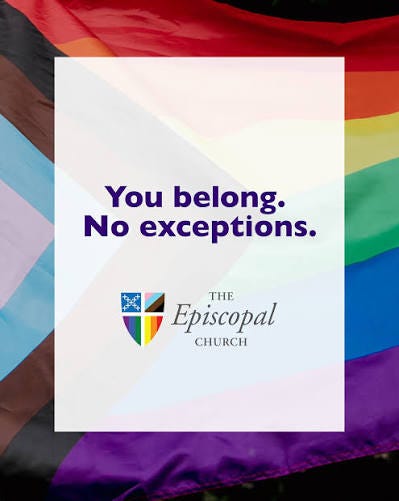
I am curious about you Omar. I googled you. You say that you are the Anglo-Calthic son of immigrant parents. I read a piece you co-authored in the Living Church. I saw the short video of your church with only the words “You belong here”posted the same day you commented on my post about the tenderness of my faith. That video is clearly not for me.
I read your essay about America, where you argue that America’s profound historical wrongs- Jim Crow, the Chinese Exclusion Act, and the xenophobia your own family has experienced- are not reasons to stop loving America. Love, you argue, does not require its object to be perfect.
If love does not require perfection, I wonder why grief does. I am also curious what about my sadness upsets you. I am curious what reconciliation you would like me to offer you for the space between the shape of my family and Canon Law.
Perhaps a deeper difference between us is what we believe the Church actually is.
From reading your work, I wonder if you see the Episcopal Church as synonymous with the gospel. For me, it never was. I thought the Episcopal Church was a community of flawed human beings trying, sometimes faithfully, sometimes terribly, to follow the gospel together. I thought the Episcopal Church prided itself on wrestling with hard questions with genuine curiosity and intellectual rigor. I saw the church as fallible and (I thought) striving ever more towards true grace and love.
I don’t deny that I violated the discipline of the Church. I did. Perhaps a better question is why. I did it for the same reason women sought ordination before it was permitted, and gay clergy came out before it was safe. I came to the point when honesty was my the most faithful response I could offer.
I knew there could be consequences. What I hoped for was not exemption from those consequences but a genuine conversation about whether the rule itself reflected the Gospel. The Church has changed its mind before about the value and dignity of people. I hoped that the church that claimed love and welcome as core values would be willing to explore human relationships with scientific, historical, and scriptural curiosity.
You identify as Anglo-Catholic, which is a tradition with a deep vein of misogyny. I won’t assume you approve of women’s ordination. Perhaps you believe the Church has also erred in allowing LGBTQ clergy. Perhaps you see me as part of the slippery slope the Church has been on for decades. But if you do believe that the Church has, at times, been wrong about who belongs, then I wonder why you believe the Church actually has the authority to mediate God’s love and welcome now.
Women were ordained before the rules changed. Countless (truly countless because we don’t know how many) gay clergy lost their vocations before the Church started marched in Pride parades and hanging up rainbow flags. The Church has changed its understanding of divorce. It has changed its understanding of gender. It has changed its understanding of marriage. Sometimes the people who force the Church to grow are precisely the ones who violate the rules.1
I aspired to stand in that lineage. I had hoped to be among the people who, in defending their own humanity to the Church, helped it grow in its ability to one day recognize what God already has.
My hope was simply to be loved as I actually am.
It is voices like yours that make me doubt that will happen in my lifetime.
I lived honestly ahead of a rule that I believed would eventually move because I had watched other rules move before. I never thought it would be easy. I did think it would at least become a conversation.
Turns out that is a conversation the Church is unwilling to have. That is one of the reasons I write this Substack, because I still wanted somewhere to have the conversation the Church refused to have with me.
My grief, my lived experience, my broken heart, my child who no longer gets to grow up in the Church are not distractions from this conversation.
I am not irrelevant to my own story, Omar.
If all we can see is monogamy as a rule that one either obeys or breaks, then I honestly believe we are failing to see the fullness and complexity of human relationships. The Episcopal Church is free to decide it does not want queer or polyamorous people in its “Body.” In fact, I wish it were more explicit about its purity culture orientation than it currently is.
The word monogamy does not appear in the Constitutions and Canons. The canonical language is “lifelong and exclusive.” The Church’s issue with polyamory rests largely in teaching documents and General Convention resolutions rather than in the Canons themselves. Monogamy is presumed but not named. Meanwhile, a great many divorced and remarried clergy continue to serve despite living outside the Church’s historic understanding of “lifelong” marriage. The Church found ways to make accommodations there.
So tell me honestly, Omar, do you really believe that a Church which has changed so many times will never change again? Do you really believe that the ladies and the queers and the transfolks should have waited quietly and patiently, never seeking ordination? Do you really believe that powerful straight white men would have eventually invited diversity to the altar unprompted?
I do have a problem with the Episcopal Church rainbow-washing its own history2, as though it were not deeply complicit in homophobia. I do have a problem with how the church denies the misogyny woven into its own traditions, and pretends that equality on paper erases the inequity that remains. I do have a problem when an institution takes credit for being welcoming only after forcing marginalized folks to do all the labor of advocating for their own inclusion. And yet, Omar, I had hoped to be one of them.
I do not expect the Episcopal Church will ever welcome me again. But please do not mistake my grief for intellectual weakness, denial, or inconsistency.
I belive that I am worthy of Love. I belive, Omar, that we all are. I miss what I loved. I miss where I thought I was loved. I am not conflicted.
Peace,
Kerlin
We believe that God loves you – no exceptions.
The Episcopal Church embraces a legacy of inclusion, aspiring to tell and exemplify God’s love for every human being; people of all genders and sexual orientations serve as bishops, priests, and deacons in our church. Laypeople and clergy work together in leadership and governance. episcopalchurch.org/what-we-believe
My first thought about Omar was, "Are these thoughts/feelings/words of yours Christlike?" I cannot imagine a Divine Spirit that would have such an approach.
And still, there is nothing outside of God....even Omar. We forgive you sir. You give us opportunity to acknowledge a deeper path. Peace be with you
Great conversation. Thank you to everyone for their tones of sincerity and respect in this space. Kerlin, you f-ing rock. Yes, yes, yes!
The thing that I pray may someday change in the EC is the bizarre panic that comes over our over-empowered bishops whenever a perceived threat to 1950’s Daddy-Knows-Best sexuality appears. To confuse issues of personal sexuality with genuine threats to the gospel, such as the obscenities of war, poverty, corruption, and human trafficking, is to completely lose one’s way. To shut down conversations and punish with extreme measures anyone who represents a more honest way of being human is simply to forget our very explicit values of dignity respect and diversity. When bishops can quietly destroy a career, a sacred calling, and a congregation in order to defend a status quo cultural norm that continues to shift and evolve, simply declaring a violation with the sweepingly vague phrase “conduct unbecoming “ (which can mean anything at all and must be preemptively intuited because it is never defined) they use a cannon to swat a mosquito, and the damage is profound. No conversation, no debate, no chance for the congregation to maintain a pastoral and sacramental relationship… just a silencing and a sweeping under the rug…. It’s just wrong. The church can do better. Thank you Kerlin for refusing to be silenced. Rank hypocrisy in the realm of sexuality has been the shame of the Church forever, and continues, sadly, today.